
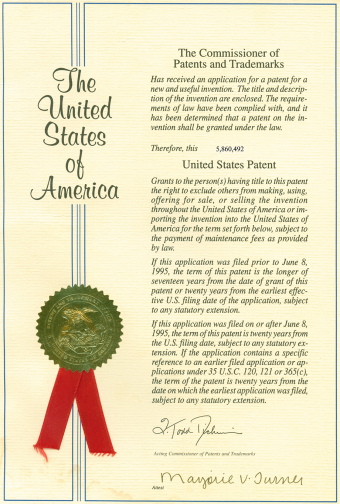
When people think about careers in biotech, they often think specifically about careers in scientific research. When we tell the story of a biotech start-up, the focus is typically on the work done by scientists and investors. The story of the Stony Brook Center for Biotechnology, told elsewhere in this exhibit, illuminates a third kind of work, that involved in building the structures, literally and figuratively, that companies need to grow, facilitating professional connections and designing incentives.
There’s a fourth kind, too: the work relating to defining and protecting intellectual property.
Historians of science have told the story of biotechnology in the United States in many different ways, focusing on different time scales and different aspects of the narrative. One theme that is emphasized across the board, however, is the development of legal structures for protecting intellectual property in biotech and the cultural changes that have made scientists increasingly comfortable with the idea of patenting their work.
The legal and institutional structures that made it possible and desirable for scientists to patent their discoveries developed over the course of the late 1960s and 1970s. Although Stanford and the University of California applied for a patent for Herbert Boyer and Stanley Cohen’s recombinant DNA method in the early 1970s, the patent was not granted until 1980. That a scientific method could be patented was not a settled question, and many scientists, including a significant number of Boyer and Cohen’s colleagues, did not consider it a good idea. It was neither obvious nor self-evident that science could be private property. What convinced many people was a re-framing of the connection between patents and the concept of public interest. Those who opposed patenting research claimed that siloing off scientific discoveries for the profit of a few was not in the interest of the scientific community or the citizens whose tax dollars had funded the research. Those who were in favor, however, argued that privatization of knowledge was for the public’s benefit, because it was only through the incentives thus provided to private industries that promising technologies would reach the market. That the government ultimately granted a patent for recombinant DNA, and that the patent turned out to be a big money-maker for those who held it, was part of an enormous sea change for molecular biology, genetics, and the life sciences in general.
1980 proved to be a turning point in the history of intellectual property in science, and not just because of the recombinant DNA patent. That year also saw the resolution of a supreme court case, Diamond v. Chakrabarty, which allowed researchers and companies to patent living organisms they had developed (the case was about a crude-oil-eating microbe developed by biochemist Ananda Chakrabarty) and which were distinct from those found in nature. In addition, the Bayh-Dole Act was passed that year. This was a piece of federal legislation that allowed universities to claim ownership of research carried out with federal funding.
Changes in the law, and changes in how some scientists and university administrators viewed ownership of scientific work, created a new world by the 1980s. This was part of the bigger context in which the biotechnology industry on Long Island developed, and one of the practical consequences was that a new career path opened up for biology and biochemistry PhDs who wanted to leave the laboratory.
The career of Stony Brook alum Pam Ancona is a prime example of this. Pam was born in Hicksville, on Long Island, and grew up nearby in Garden City. As an undergraduate at Hofstra, she decided to study chemistry, with a minor in math, because it had been the subject she liked most in high school. “It turned out that it was a good [decision] because I still love it.” What was it about chemistry that she loved? “I just thought it was just fun. It was just– Even now I’m doing other things that branch out from chemistry, there’s never any end to the things that you can learn about. You’re never done. It is just fun. I don’t know any other way to put it.” There are endless problems out there to solve, and solving them requires not just technical knowledge but also an enormous amount of creativity.
Pam’s MA work at Columbia, a biomimetic synthesis of morphine, illustrates the kind of challenge she enjoyed as a student. “Chemists know morphine, it’s a classical backbone, or opiate structures are classical backbones.” What she was trying to do was come up with a way to build that backbone in a different way, to synthesize it not as this was typically done in the lab, but “to synthesize it the way the nature synthesizes it. Nature synthesizes it in a specific type of pattern.” It “builds blocks onto the molecule in a particular pattern…What we were trying to do follow the rules that nature had made up for the way that you build this backbone.” The project did not work out in the end, but it was a fun problem to play with, as well as illustrating how organic chemistry research is connected to pharmaceutical research: “The long term goal of all this type of work is to make new drug candidates, to really understand how the body does things, and then you can make a better drug.”
After her MA at Columbia, Pam went on to do a PhD at Stony Brook, working with Glenn Prestwich, a professor of chemistry who also served as director of the Stony Brook Center for Biotechnology from 1992 to 1996. One of the projects she worked on there focused on the synthesis of cholesterol, with the goal of “making molecules that could inhibit cholesterol synthesis in the body…. We were trying to understand the enzymes that are part of that synthetic workflow in the body so that you could make drugs that fit within the molecular structure of the enzyme so that it could stop it more effectively.” In other words, if you have a full understanding of the process the body uses to synthesize cholesterol, you can design more effective ways of halting that process and putting a damper on the amount of cholesterol the body makes.
Pam got her PhD in 1995, which meant that she was at Stony Brook as the Center for Biotechnology was taking shape and a lot of effort at Stony Brook and elsewhere in the region was being put into the development of a biotech industry on Long Island. What was her impression of biotech then?
For one thing, the term “biotech” was and remains a “nebulous descriptor. Even now it’s very broad, and it covers so many things that it’s arguably meaningless.” What would be a better way to talk about the type of applied research that tends to fall under this umbrella? “I’d have to think about that. It’s all a branch of medicinal chemistry, at least the areas that I was working in. It was a branch of drug discovery, because then when I moved a little later on, I moved to Pfizer. I was doing similar things or I was working with scientists who were doing similar things.”
But at the time, she wasn’t really thinking about the state of the industry as a whole. There were two issues of more immediate relevance for a recent PhD: one was the state of the job market, and the other was the realization that despite the fact that she loved chemistry, she did not enjoy lab work. Her advisor, Glenn Prestwich, made a suggestion: how about doing some biotech patent-related work at a local law firm? Stony Brook’s Center for Biotechnology was developing a law internship program for young scientists, and she could be the first to give it a shot.
Pam Ancona, interviewed by phone on July 28, 2023
Interviewer: Antoinette Sutto
Antoinette: What was that like? Did you feel like a guinea pig?
Pam: I didn’t exactly feel like a guinea pig. I jumped in wholeheartedly because [Glenn] recognized at that time– The natural path for everybody in his lab was that they would graduate. They would go and do a postdoctoral work for however long and then you get a job. Or you may end up doing two postdocs before you get a job.
Antoinette: Or you may not get a job.
Pam: At the time– Yes, and you might get a job that has nothing whatsoever to do with what you want to do. At that point in time, maybe it’s lightened up, I don’t really know, but it was very difficult to get a postdoc and even harder to get a job. I know at the time that I was looking around and thinking about this, there was a guy that was in my lab who was– He was several years ahead of me. He was already completing his postdoc in Glenn’s lab. He was looking for years for his next job, and he ended up getting a job at, I think it was at a pharmaceutical company, and it was working with radioactive materials.
He liked doing that. Honestly, I liked doing that because I did do that in Glenn’s lab. But that is not something you want to do for a long term. Yet, it was the only job that he could get. It just made me feel sort of God, I got to think about what the options are here because this isn’t necessarily viable long term. I was honest with myself at that point. Part of me wishes I had been a little honest earlier on that I always hated lab work. I hated it when I was an undergraduate. I always thought oh, it’s the project, that’s why I don’t like this. I always thought the next project would be better.
After several years and going through graduate school, I realized next project didn’t make it better. I really didn’t like it. There were only like I said the working in with the radioactive materials was the only project at Stony Brook that I genuinely liked. Every bit of it was drudgery other than that. I thought, well, let me try this because the alternative is more lab work, which is just something I couldn’t wrap my mind around.
I jumped into working at the law firm and never looked back. It was everything that I loved about science, and I didn’t have to do the lab work. I couldn’t really get enough of it, and it would just whet my appetite for whatever was to come next. It didn’t bother me that if I go down this path, I would have to go to more school. That didn’t bother me at all.
Antoinette: The law had these same elements that science does. The analytical problem-solving side and there’s no labwork.
Pam: Yes.
Antoinette: You knew that this internship exists, and that was when you thought, oh, this is another really viable option.
Pam: [Glenn] came to me with it. He told me about it. He knew I didn’t really enjoy the lab work, and he said maybe you might want to give this a shot.
Antoinette: Okay.
Pam: It was only one semester, so if it didn’t work out, it was not a big deal.
Antoinette: It wasn’t high stakes.
Pam: Yes.
Antoinette: You worked as an intern at which law firm was it?
Pam: Scully, Scott, Murphy, & Presser. They’re still around.
Antoinette: What was the first name again?
Pam: Scully, S-C-U-L-L-Y.
Antoinette: Oh, Scully, like Agent Scully. Okay.
Pam: Yes. [laughs]
Antoinette: What exactly did you do on a day-to-day basis when you were there?
Pam: I did a variety of things. I did a little bit of patent prosecutions. What that is, is I didn’t write any patent applications that I remember because that’s a big task, and it’s not something you can really do part-time, and that was all I was doing. It was just two days a week, so it wasn’t really enough for that. What I did, under the guidance of a patent agent at the law firm, was that I worked on responses to the US Patent Office in order to get a patent application allowed.
What’ll happen when you file a patent application, it goes to an examiner at the patent office around the world, but the ones I was dealing with were in the US at the time. The examiner will look at it, and sometimes you might get it allowed right out of the gate, but more commonly, the examiner will look at it and probably do a search to see what’s out there, that looks a lot like that thing that you’re trying to patent. Then you’ll have an argument back and forth, on paper for the most part, about how what you are trying to protect is different than what the examiner has found out there in the literature.
That was what I mainly worked on, was crafting those arguments. I guess it just appealed to me too. I’m like, I like the argumentative side of this. That’s obviously something you don’t get in pure science.
Antoinette: Oh, you might get it in a different way in terms– Yes, but no, I see what you mean, I see what you mean. Did you feel– You were coming from a very pure science background. Did you feel like there was an element of culture shock suddenly working with attorneys?
Pam: I didn’t really feel that way. Maybe it might be because of the law firm that I was at. I think if I had done the same internship at a law firm in New York, there would’ve been a culture shock, but the law firm that I was at was on Long Island. It was a little bit more low-key relative to New York law firms, so I never really found it as a culture shock. They were very welcoming.
Antoinette: They were really– It sounds like Glenn at Stony Brook was really interested in doing this. And sounds like this law firm in particular was interested in getting these science PhDs in there as something that would be useful to them as well.
Pam: Yes, because the other thing at that time, it was a relatively new phenomenon, but law firms, patent law firms suddenly realized that they should try to recruit people straight out of graduate school to come and work at a law firm, become a patent agent, and then maybe eventually they become a patent attorney. As the technology, especially in the biotech area, got more and more complex, they needed people with advanced degrees.
Scully, Scott was one of them. There were a couple of law firms in New York, and then it branched out up and down the east coast that they had programs where they would recruit people from graduate school. They would even have like a class of graduate students who had just recently graduated from graduate school. They come to the law firm, and they take this path, and then the law firm puts them to school. Puts them through school, pays for school, for law school, while they’re working.
When I started, it was right around the time that that began, so it was just dumb luck. I think the firm that I interned at, they didn’t have a formal program just yet. They had one patent agent who had started there, I think, several years before, and she was going to law school. The firm wasn’t sending her to law school, so they were just dipping their toes in the water that other law firms had already gone down the road with. They wanted to see what it was like. They thought that doing this internship program would give them an idea of what kind of work they could expect out of a graduate student fresh out of graduate school.
Antoinette: The law firm you were at, they saw that, “Okay, other law firms are dipping their toes into this. If we work with Stony Brook and have these young scientists come in, we can get a sense of will this work for us. Is this something we want to do?”
Pam Ancona, interviewed by phone on July 28, 2023
Interviewer: Antoinette Sutto
Pam: Yes. I think Stony Brook was a client. [crosstalk]
Antoinette: Oh, okay. There was an existing business relationship.
Pam: Yes, I think that was how the connection was made. I know that, too, the reason why Glenn got interested in it was because he got a couple of patents granted. All of a sudden, he realized, “Oh, wait a minute. There’s a lot of value in a patent.” It was just as valuable as a publication, which at the time was a little bit of a controversial statement for a university professor.
Pam did her work with Scully, Scott, Murphy, & Presser in the mid-90s, when a number of important shifts were taking place in academia and in industry. Faculty like Glenn Prestwich were becoming more interested in collaborations with industry, and with the value of patenting research. Twenty years earlier, the situation would have been very different. And on the other side, specialists in industry were realizing that people with both scientific and legal expertise were invaluable in the process of developing and protecting scientific intellectual property.
After completing her law degree in 2001, Pam went on to work for several large pharmaceutical companies, including Pfizer and Roche, where she is currently (2023) head of Intellectual Property, Molecular Customer Area. She has had the chance to be closely involved in cutting-edge science without being in the lab. One thing she emphasizes as a patent attorney in the pharmaceutical/biomedical world is that “when you work with inventors, you always have to have the technical ability to put an inventor hat on yourself. You’re adding to that patent application. You’re trying to get them to broaden it out as much as possible.”
To illustrate this, she describes a project she was working on for a large chocolate company, during which the entire team was “holed up in a hotel outside of Hackettstown, New Jersey,” for three days trying to nail down the details of a patent relating to chemical compounds in chocolate. Her colleagues “would say to me, “Okay, it has to have elements A, B, and C.” Then my job as a patent attorney is to say, “Okay, well, what about if you change C to C2?” Then just understanding the science, I have to make the right suggestions, and I have to feed them suggestions. Then that sparks them to maybe broaden out what they were thinking of. That’s the fun part of this.”